
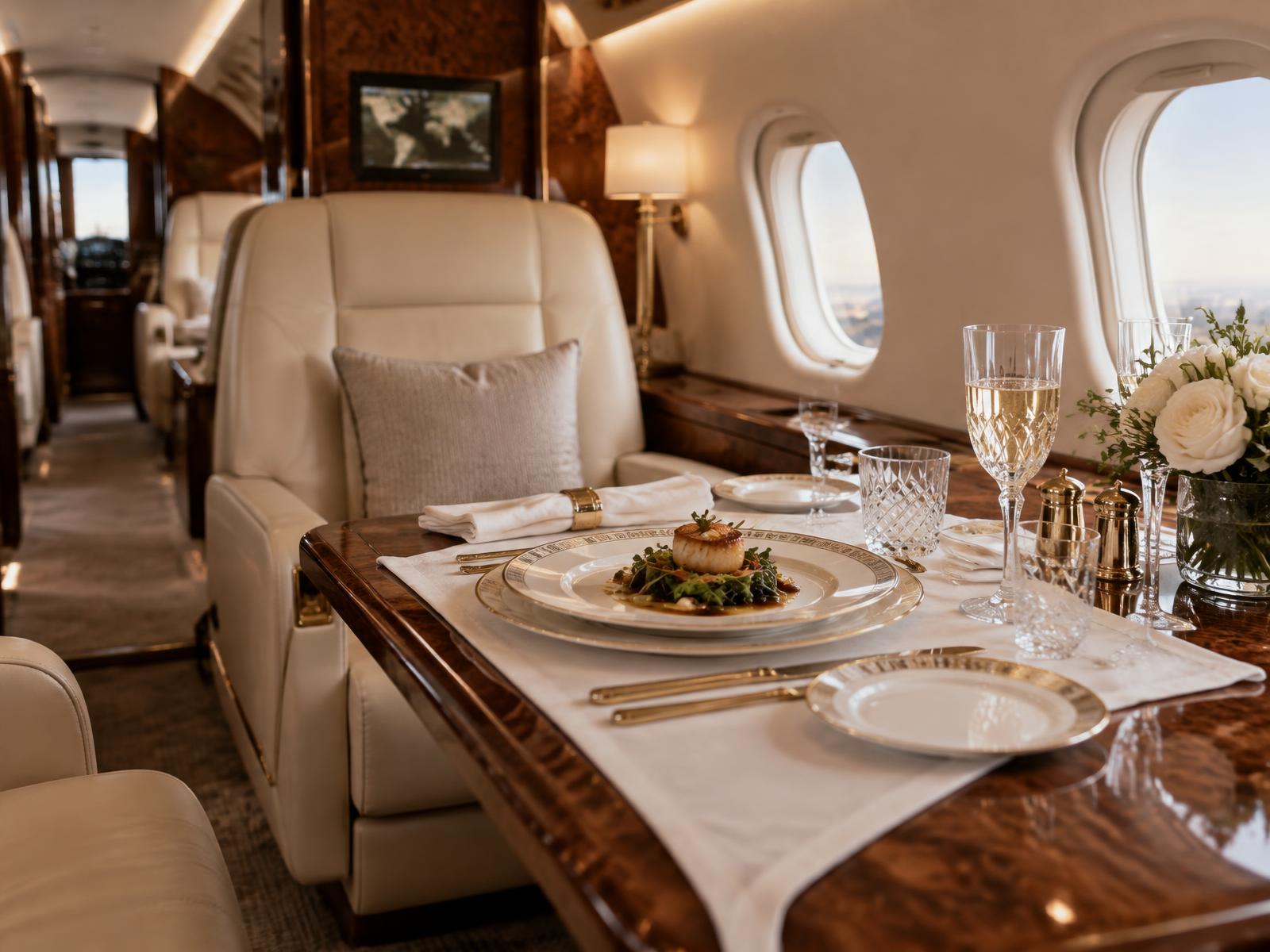
On a short private flight, a successful meal service depends less on how much food is available than on how easily it can be served and enjoyed. The useful dining window may be considerably shorter than the scheduled flight time once departure, cabin readiness and arrival preparation are considered. For flight departments and cabin crew, the practical task is to design a service that feels unhurried without assuming every minute in the air will be available. That starts with the sequence of work, not the number of courses.
Plan around the usable service window
Treat scheduled flight time as a planning reference, not a promise of dining time. Before choosing a service style, consider when the crew can safely begin, how much preparation the meal requires and when everything must be secured for arrival. Expected conditions and operating requirements can change that window. Service plans should always remain subordinate to crew instructions and the operator’s procedures, including any restrictions on movement or use of galley equipment.
Build the meal around a complete first offering rather than a sequence that only feels complete after several courses. A satisfying main selection with its accompaniments can stand on its own if service must end early. A starter or dessert can remain optional. This gives the crew a natural stopping point and avoids leaving passengers waiting for the essential part of lunch while the aircraft is already approaching its destination.
Choose food by the work it creates
Evaluate each menu item as a set of cabin tasks. Does it need heating, slicing, dressing, garnishing or assembly? Does it require separate utensils or several small containers? A dish that looks simple on a menu can occupy both hands and most of the available workspace. For a compressed service, favor selections that need few finishing steps and can be presented neatly without prolonged attention in the galley.
Cold meals can remove reheating from the sequence, but they still need thoughtful design. Consider ease of cutting, dressing control and whether components stay appealing during service. If a warm meal is preferred, confirm the actual equipment and its capacity before committing to multiple hot elements. Avoid making several components depend on the same appliance at the same moment. The objective is reliable execution, not simply a shorter menu.
Match presentation to the cabin
Presentation changes the amount of handling required after departure. Individual boxes can keep each passenger’s meal together and reduce distribution steps. Shared platters may suit a group that wants to graze, but they require accessible space and a workable serving arrangement. A VIP box offers another individual format. Altitude offers these presentation choices; the useful decision is which format fits the cabin layout, passenger preferences and crew resources for that flight.
Think through the physical path from storage to the passenger and back again. A format that fits comfortably on a table may still be awkward to open in a narrow workspace. Check where lids, serving utensils and used items will go. Keep dietary meals identifiable throughout distribution, and avoid arrangements that require the crew to separate portions or distinguish similar looking dishes under time pressure. Clear identification supports both accuracy and discreet service.
Keep beverages from becoming a separate project
Beverage service can compete with meal preparation for workspace and crew attention. Decide whether drinks will precede the food or accompany the first offering, allowing for passenger preferences and safe service conditions. Familiar selections with straightforward preparation are often easier to manage than several individually assembled drinks. Exact brands and counts can be specified when ordering from Altitude, helping the crew know what is available without searching through an assortment.
Where preferences are known, use them to reduce unnecessary choices rather than remove hospitality. Have the expected beverage and its service items accessible, with alternatives available if requested. Hot drinks deserve their own timing decision because preparation, distribution and collection all take attention. On a particularly short sector, it may be more comfortable to offer them only when there is sufficient time for passengers to enjoy them before arrival preparation begins.
Agree on the shorter version before departure
Every short flight benefits from a reduced service plan that the crew can adopt without improvising. Identify which elements are essential, which are optional and which should be omitted if conditions interrupt service. The shorter version should still feel intentional: one complete meal, an appropriate beverage and a clean conclusion. Do not rely on making up lost time through faster movement or by delaying required cabin preparation for landing.